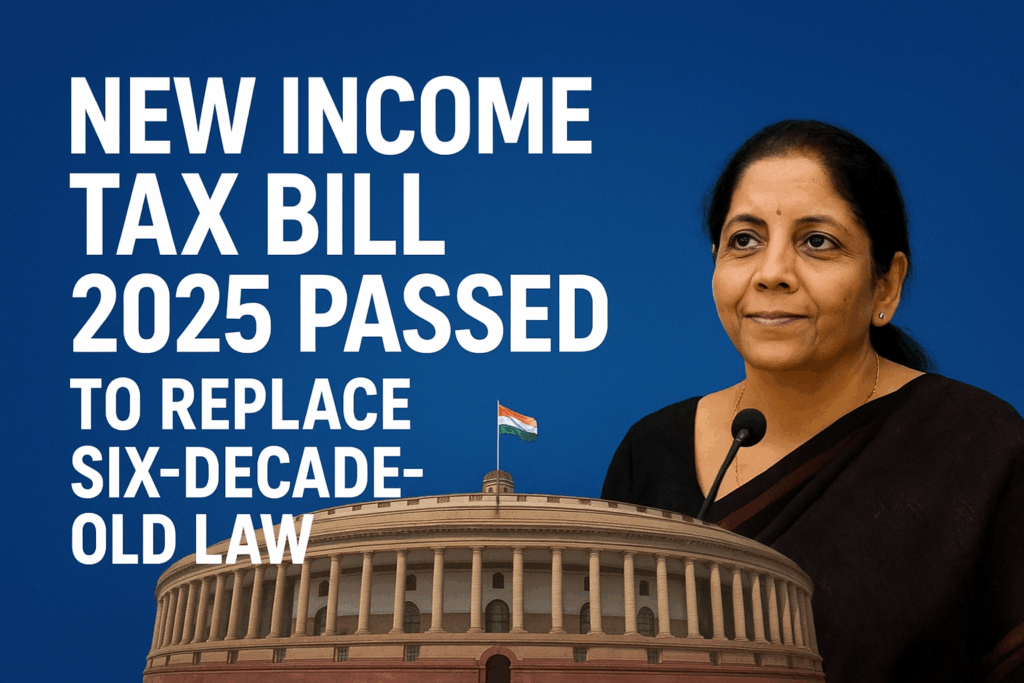
The Income-tax Act of 2025’s concept of the tax year
With effect from April 1, 2026, the Income-tax Act, 2025 undergoes a major structural change with the introduction of the notion of “Tax Year.” This modification seeks to increase clarity, streamline tax jargon, and bring India’s tax system into line with international standards.
A Tax Year: What Is It?
The 12-month period that income is earned and taxed throughout, starting on April 1 and ending on March 31, is referred to as the “Tax Year” under the new law. It takes the place of the two ideas of: • The prior year (PY)
• The Income-tax Act of 1961 established the Assessment Year (AY).
Justification for the Modification
Particularly for taxpayers and experts working in compliance and advice, the previous method frequently caused misunderstanding. For example, income from the previous year, FY 2024–2025, was evaluated in AY 2025–2026. Errors in files, notices, and interpretation were often caused by this dual-year reference.
The new approach removes uncertainty by establishing a single Tax Year. Compliance will now be easier to understand since income received during a financial period will be evaluated within the designated year.
Consequences for Experts
This change has various practical ramifications for corporate professionals, tax experts, and chartered accountants: • Simplified Documentation: A single year will now be mentioned in returns, audit reports, and notices. • Lower Litigation Risk: Fewer mistakes resulting from inaccurate year references • Improved Client Communication: Simpler explanations of deadlines and responsibilities • System Alignment: The new language will need to be reflected in accounting, ERP, and compliance software. 📅 Transitional Considerations
Careful handling of current assessments, pending litigation, and carry-forward items like losses or credits will be necessary during the shift to the Tax Year concept. Experts need to make sure:
- Accurately mapping previous Assessment Years to the new Tax Year structure
• Reporting consistency throughout transitional filings
• Transparent disclosure in tax reports and financial statements - Compliance with International Standards
The majority of countries in the world use a single-year tax reference system, sometimes known as a “tax year” or “fiscal year.” The change improves cross-border understanding and ease of doing business by bringing India closer to global best practices._______________________________________ 📌
Conclusion
The Income-tax Act, 2025’s introduction of the Tax Year is a move in the right direction toward modernising and streamlining India’s tax system. Although the change seems to be terminological, it has a significant impact on professional practice and compliance efficiency. In order to guarantee a smooth transition and ongoing compliance in the changing regulatory environment, tax professionals must proactively adapt.